

EU Battery Removability Rules 2027: Does Every Product Need a User-Replaceable Battery?
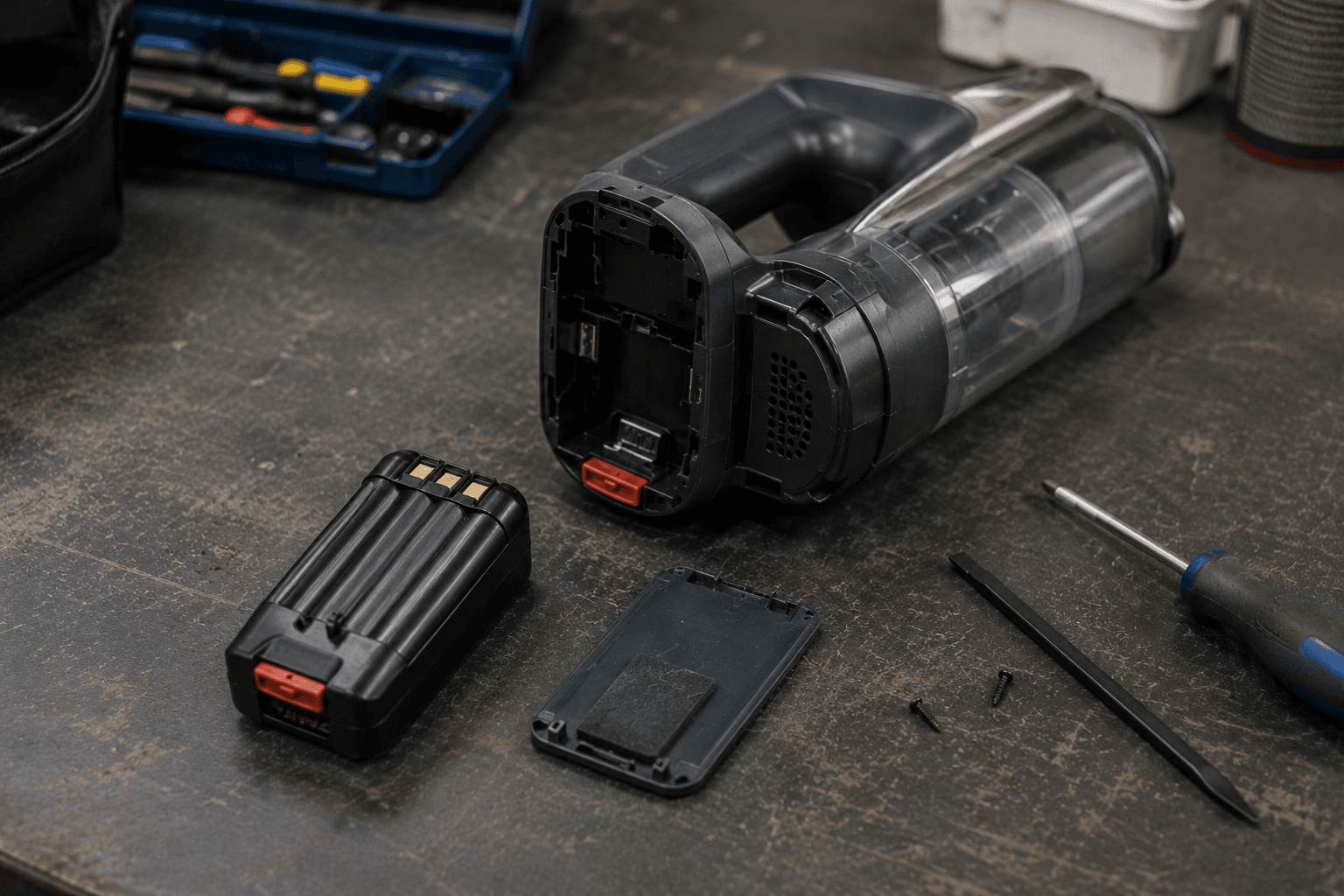
From 18 February 2027, many products containing portable batteries must be designed so that the battery can be removed and replaced by the end user.
The requirement is broad, but it is not a universal ban on built-in batteries.
The EU Batteries Regulation includes exceptions for products where consumer access to the battery would create safety or data-integrity risks. Other products may be designed so that the battery is replaced by an independent professional rather than the user. Specific EU product rules can also take precedence over the general battery requirements.
For manufacturers, private-label businesses and importers, the key question is therefore not simply whether a product contains a fixed battery. The product, battery category, intended use, design and applicable sector legislation must be assessed together.
What changes on 18 February 2027?
Article 11 of Regulation (EU) 2023/1542 applies from 18 February 2027.
Its general rule requires any person placing a product containing a portable battery on the EU market to ensure that the complete battery is readily removable and replaceable by the end user throughout the product’s lifetime.
Portable batteries are broadly defined as sealed batteries weighing 5 kg or less that are not designed specifically for industrial use and do not belong to the electric vehicle, light means of transport or starting, lighting and ignition battery categories.
The obligation applies to products placed on the market from the application date. It does not require companies to redesign every product that was already placed on the EU market before 18 February 2027.
The regulation also contains a separate rule for batteries used in light means of transport, such as electric bicycles and electric scooters. These batteries, including the individual cells within their battery packs, must be removable and replaceable by independent professionals.
What does “readily removable” mean?
A user-replaceable battery does not necessarily have to be removable without tools.
The battery can be considered readily removable where an end user can take it out using commercially available tools. The process must not require proprietary tools, heat or solvents to open the product.
A specialised tool may be required only where it is supplied free of charge with the product.
The removal process must also avoid damaging the battery or the product. Once the battery has been replaced, the product must continue to operate without an adverse effect on its functionality, performance or safety.
The requirement applies to the complete portable battery. It does not generally require consumers to replace individual cells within a battery pack.
Companies placing affected products on the market must provide instructions and safety information covering the use, removal and replacement of the battery.
Replacement is not limited to the original battery
A product should not be designed so that it can function only with a replacement supplied by the original manufacturer.
The regulation refers to replacement with a compatible battery. Compatibility depends on whether the replacement allows the product to operate as intended without creating a risk to the user, the battery or the product.
Relevant technical characteristics can include:
- battery chemistry and capacity;
- dimensions and connection type;
- voltage and charging parameters;
- thermal behaviour;
- product-safety requirements;
- applicable type-approval conditions.
A manufacturer may define the technical specifications that a compatible battery must meet. It cannot use those specifications merely to prevent the use of safe third-party alternatives.
This distinction is important for products that use battery serialisation or software-based component authentication.
Can software restrict battery replacement?
Software may be used to establish secure communication between a product and its battery. It may also verify whether a replacement meets the necessary safety and functional requirements.
It must not be used to prevent the installation of an otherwise compatible battery.
Practices commonly described as parts pairing can become problematic where a replacement battery loses functions, triggers permanent warnings or cannot operate unless it is remotely authorised by the original manufacturer.
The relevant question is whether the software control is objectively required for safety and correct operation or whether it effectively prevents replacement with compatible batteries.
Manufacturers should therefore assess the physical battery design and the software environment together. A battery that can be physically removed may still fail the replaceability requirement if software prevents the replacement from functioning properly.
Spare batteries must remain available
Portable and LMT batteries covered by Article 11 must be available as spare parts for at least five years after the last unit of the relevant equipment model has been placed on the market.
They must be offered to end users and independent professionals at a reasonable and non-discriminatory price.
Where replacement requires additional components, such as single-use fasteners, those parts may also need to remain available. A replaceable battery is of limited practical value if the product cannot be safely reassembled after it has been removed.
The five-year requirement is a minimum. More specific EU legislation may require spare parts to remain available for longer.
For example, separate ecodesign requirements apply to smartphones and certain other communication devices.
Do the general rules apply to smartphones?
The Batteries Regulation should not be read in isolation for smartphones, mobile phones other than smartphones, cordless phones and slate tablets.
These products are already covered by specific ecodesign rules under Regulation (EU) 2023/1670. The Commission’s battery guidance states that those more specific removability and replaceability requirements take precedence.
The ecodesign framework provides different compliance routes. Depending on the product design and battery durability, replacement may be possible for a layperson, a person with general repair knowledge or a professional repairer.
A statement that all smartphones must return to the tool-free, removable battery designs commonly used in earlier mobile phones is therefore misleading.
The manufacturer must assess the specific ecodesign criteria applicable to the device rather than rely only on the general wording of Article 11 of the Batteries Regulation.
Products that may themselves be batteries
Article 11 applies to products that incorporate portable batteries.
Some devices commonly described as products with built-in batteries may instead constitute batteries themselves because their primary function is to supply electrical energy to another product.
Depending on their design and intended function, examples may include:
- rechargeable power banks;
- charging cases for earbuds or hearing devices;
- portable vehicle jump starters.
Where the complete product is legally classified as a portable battery, the rules for products incorporating portable batteries may not apply in the same way.
This does not remove the product from the Batteries Regulation. Other obligations concerning safety, conformity, labelling, substances, producer registration and waste management can still apply.
An exemption does not always mean a permanently fixed battery
The Batteries Regulation contains different types of derogation. They should not be treated as interchangeable.
Under a partial derogation, the battery does not have to be removable by the end user. It must instead be removable and replaceable by an independent professional using commercially available tools.
This approach applies where consumer access would create an unacceptable safety risk but professional replacement remains possible.
A separate derogation applies where continuity of power supply and a permanent connection are necessary for user or product safety. It can also apply to products whose main function is collecting and supplying data where a battery disconnection would compromise data integrity.
These cases may fall outside the general end-user removability and replaceability obligation altogether.
The presence of a safety function, sensor or memory component is not sufficient by itself. The permanent connection must be necessary for the relevant safety or data-integrity purpose.
Wet appliances
Products specifically designed to operate primarily in an environment regularly exposed to splashing water, water streams or immersion may qualify for professional-only battery replacement where they are intended to be washed or rinsed.
Potential examples include certain:
- electric toothbrushes and water flossers;
- shavers, hair clippers and epilators;
- floor-cleaning appliances;
- wearable or outdoor devices designed for regular water exposure.
A water-resistance rating alone does not establish that the derogation applies.
The company must be able to show that the product is primarily intended to operate in the relevant wet environment and that end-user battery replacement would compromise safety. It must also consider whether the product could be redesigned using current technology without seriously affecting its safety, performance or function.
An IP rating can support the assessment, but it is not sufficient evidence on its own.
Medical and safety-critical products
The regulation already recognises professional medical imaging and radiotherapy equipment and in-vitro diagnostic medical devices as product groups for which professional replacement may be sufficient.
Other products may qualify for the broader safety derogation where uninterrupted power and a permanent battery connection are necessary.
Examples identified in the Commission guidance include certain implantable or life-sustaining medical devices, safety equipment and devices whose operation must not be interrupted.
The same reasoning may be relevant to specific fire, smoke, gas or carbon-monoxide alarms designed for long-term uninterrupted operation, provided the legal conditions are met.
The exemption is not based solely on the product being used in a medical, industrial or safety-related environment. The intended use, risk classification and technical need for a permanent connection remain decisive.
Data integrity is a narrow exemption
A product may qualify for an exemption where its main function is collecting and supplying data and interrupting the battery connection would compromise the integrity of that data.
Potential examples include certain professional monitoring systems, environmental sensors, laboratory equipment and devices used for the continuous monitoring of temperature-sensitive goods.
The exemption can also be relevant where a battery maintains volatile memory or a critical internal clock.
It is not intended to cover every connected product.
A device does not qualify simply because it records user settings, includes an optional sensor or transmits data as an additional feature. The collection and supply of data must be a main function, and the loss of battery continuity must create a genuine data-integrity risk.
Additional product exemptions adopted in July 2026
On 14 July 2026, the European Commission adopted a delegated act adding further product categories to the professional-replacement derogation.
The additions cover certain:
- wearable devices;
- electric toys with rechargeable batteries;
- wireless thermometer probes designed for food contact;
- products used in potentially explosive atmospheres under the ATEX framework;
- body-worn systems for the subcutaneous administration of medicinal products;
- roof-mounted telematics devices for agricultural and construction machinery.
The delegated act does not provide an automatic exemption for every product within these broad commercial descriptions.
For wearables, for example, consumer access must compromise safety, durability or water resistance, and the product must either be too small for safe consumer handling or rely on a compact, sealed enclosure for its functional integrity.
The temporary provision for electric toys is intended to apply until 31 July 2030 and only where professional replacement is necessary for toy safety.
At the time of writing, the delegated act has been adopted by the Commission but has not yet completed scrutiny by the European Parliament and the Council or entered into force. It will apply only after the legislative scrutiny process and publication in the Official Journal have been completed.
Companies should therefore distinguish between the Batteries Regulation currently in force and the additional exemptions that are still completing the EU adoption process.
What qualifies as an independent professional?
An independent professional is expected to have the technical competence and qualifications needed to repair the product containing the battery and to perform the activity commercially.
Depending on the product and national rules, relevant evidence may include professional registration, technical training, certification or manufacturer-approved training.
The professional does not necessarily have to belong to the manufacturer’s own service network.
The concept is intended to allow competent third-party repairers to perform the battery replacement. Manufacturers must not structure access to tools, parts or information in a way that makes independent replacement practically impossible.
Where special tools are needed for LMT batteries, they should be available to independent professionals at a reasonable and non-discriminatory price.
Special rules for LMT batteries
Batteries for light means of transport follow a different model from ordinary portable batteries.
They do not generally have to be replaceable by the consumer. They must be removable and replaceable by an independent professional throughout the product’s lifetime.
The requirement extends to individual cells within the battery pack.
This does not mean that every cell can be replaced without regard to battery safety or vehicle approval. The replacement must preserve the safety of the battery pack and comply with applicable technical parameters, safety protocols, standards and type-approval requirements.
Manufacturers of e-bikes, e-scooters and similar vehicles therefore need to consider access to the complete battery, the internal pack design, diagnostic systems and the availability of cells and other key components.
Who is responsible?
Article 11 addresses the person that places the product containing the battery on the EU market.
Depending on the supply chain, this may be:
- an EU product manufacturer;
- a company selling the product under its own name or trademark;
- an importer of products manufactured outside the EU;
- another business first making the product available on the EU market.
A private-label company cannot assume that the physical manufacturer is solely responsible. An EU importer cannot rely only on a supplier’s general statement that the battery is replaceable.
The responsible economic operator must be able to demonstrate that the product meets the applicable design requirements and that any derogation used is legally and technically justified.
Supplier agreements should provide access to the design information, test results, replacement instructions, battery specifications and supporting evidence needed for that assessment.
The new rules are a product compliance requirement
Battery removability is a condition affecting the design and lawful placing of a product on the EU market.
It is not limited to repair services provided after a product fails.
This distinguishes Article 11 from the EU Right to Repair framework. Right to Repair determines when consumers can request the repair of certain products and which economic operator must provide it. Battery removability determines how products must be designed before they are sold.
The two frameworks may apply to the same product, but they regulate different obligations.
Battery removability does not replace EPR
A compliant battery design does not satisfy national battery or WEEE Extended Producer Responsibility obligations.
A company placing a battery-powered electrical product on several European markets may still need to:
- register as a battery producer;
- register as a WEEE producer;
- appoint authorised representatives;
- report product and battery quantities;
- finance collection and treatment;
- meet national take-back and consumer-information requirements.
The legal entity responsible for the product’s battery design is not necessarily the EPR producer in every destination country.
Product conformity and national EPR responsibilities must therefore be assessed separately.
The compliance impact extends beyond the battery compartment
The 2027 requirements affect product architecture, fastening methods, sealing, software, spare-parts planning, technical documentation and supplier contracts.
They do not require every battery-powered product to use the same design. They do require companies to identify which legal route their product follows and to support that conclusion with appropriate evidence.
For many products, end-user replacement will be the default. For others, professional replacement will be sufficient. A narrower group may qualify for an exemption based on the need for a permanent battery connection.
The distinction cannot be made reliably from a product name, IP rating or marketing description alone.
Viron Compliance supports manufacturers, importers and online sellers in separating EU product requirements from national battery and WEEE EPR obligations. We manage producer registrations, authorised representation and ongoing reporting across European markets.